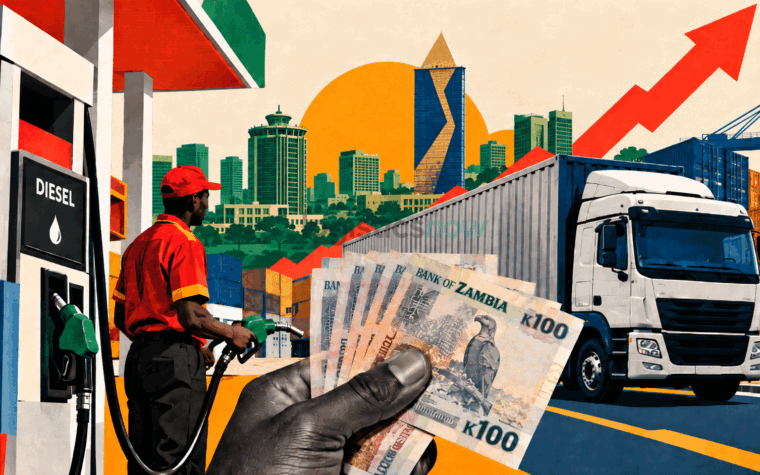




















Zambia’s Energy Regulation Board has raised diesel prices to K33.27 per litre, adding fresh cost pressures for transporters, logistics operators and businesses that depend on road freight.
The Increase
Zambia’s transport and logistics industry is entering October with a significantly higher fuel bill following the Energy Regulation Board’s (ERB) latest petroleum pump price adjustment.
Effective midnight on 30 September 2026, diesel prices increased from K26.86 to K33.27 per litre, marking a substantial monthly adjustment for commercial transport operators.
The increase comes as government begins withdrawing temporary tax-relief measures introduced earlier in the year to cushion consumers and businesses against rising petroleum costs.
For an industry heavily dependent on diesel-powered fleets, the adjustment introduces immediate pressure on transport operating costs.
The Quantum
Diesel recorded a 23.9% increase, adding K6.41 to every litre purchased.
Petrol increased by 24.4%, while kerosene and Jet A-1 also recorded upward adjustments.
The new prices are:
- Petrol: Up 24.4%, from K25.29 to K31.46 per litre.
- Diesel: Up 23.9%, from K26.86 to K33.27 per litre.
- Kerosene: Up 10.2%, from K27.02 to K29.76 per litre.
- Jet A-1: Up 10.9%, from K28.71 to K31.85 per litre.
For transport operators, the cost impact becomes clearer at fleet level.
A heavy truck consuming 35 litres of diesel per 100 kilometres would require approximately 700 litres for a 2,000-kilometre journey.
At September’s pump price, that fuel would have cost K18,802. At the new October price, it costs K23,289.
That is an additional K4,487 for one truck on one journey, before accounting for maintenance, driver allowances, tolls and other operating expenses.
For a fleet of 20 trucks making the same journey, the additional diesel expenditure would reach K89,740.
These are illustrative calculations based on the announced pump prices. Actual fleet costs will depend on vehicle consumption, route conditions and fuel procurement arrangements.
The Drivers
According to ERB, the October price adjustment reflects three principal factors: higher international petroleum prices, depreciation of the kwacha and the reinstatement of excise duty.
International petroleum prices: ERB reported that average international diesel prices increased from US$150.92 to US$160.88 per barrel during the review period, while petrol prices rose from US$104.94 to US$121.58 per barrel.
Exchange-rate movements: The kwacha weakened from approximately K19.28 to K19.76 against the US dollar. Because Zambia imports petroleum products, exchange-rate depreciation increases the local-currency cost of fuel imports.
Reinstatement of excise duty: Government had suspended excise duty and zero-rated VAT on petroleum products between April and September 2026 to moderate domestic pump prices.
The measures helped cushion consumers and businesses from the full impact of international petroleum price movements, but came at the expense of foregone government tax revenue.
The total fiscal cost of the relief measures has not been quantified in ERB’s October announcement.
With the temporary relief period ending, excise duty has returned from October.
VAT is scheduled to be reinstated on 1 December 2026, adding another consideration for businesses planning their fuel budgets over the coming months.
The latest adjustment therefore reflects both international market conditions and changes to the domestic petroleum tax structure.
The Implications
The immediate pressure point is the cost of moving goods.
Diesel represents a significant variable expense for road transport operators, particularly those serving Zambia’s domestic distribution networks and regional trade corridors.
A near-24% increase in diesel prices does not automatically translate into an equivalent increase in freight rates, but it materially changes the cost assumptions underlying transport contracts.
For transporters, the adjustment creates pressure to review freight quotations, fuel surcharges and existing service agreements. Operators on fixed-rate contracts may have to absorb higher costs until renegotiation, while those with fuel-adjustment clauses may be able to recover the increase more quickly.
For mining and industrial supply chains, higher diesel prices increase the cost of transporting inputs, equipment, consumables and mineral products. Diesel-powered site operations may also face additional expenditure.
For FMCG distributors and retailers, the increase raises the cost of moving products between factories, distribution centres and retail outlets. Businesses with extensive delivery networks could face greater pressure on distribution margins.
For regional freight, the additional cost becomes particularly significant over long distances. Routes connecting Zambia to Dar es Salaam, Beira, Walvis Bay and other regional gateways require substantial fuel volumes, making fleet efficiency and backhaul utilisation increasingly important.
The adjustment also strengthens the business case for fuel monitoring, route optimisation, preventive maintenance and driver-efficiency programmes.
These measures cannot eliminate higher pump prices, but they can help reduce fuel consumption and limit the impact on operating margins.
LN Signal
October’s diesel increase is more than a monthly pump-price adjustment. It represents a significant change in the operating economics of road transport.
For fleet operators, the immediate priority is understanding the additional fuel cost per kilometre and how much can be recovered through existing customer contracts.
For cargo owners, the question is how quickly higher transport costs will begin appearing in freight quotations and distribution budgets.
But there is another development to watch.
ERB says VAT on petroleum products will be reinstated from 1 December 2026, creating another potential cost pressure point for transport and logistics operators.
The October adjustment should therefore prompt businesses to review more than their immediate fuel budgets. It is also an opportunity to reassess contract structures, fuel-adjustment mechanisms and fleet productivity.
The Logistics Now signal: Diesel has become 23.9% more expensive in a single review cycle. The real business impact will be determined by how efficiently operators use that fuel — and how effectively the additional cost is managed across the supply chain.
Source: Energy Regulation Board (ERB), October 2026 Petroleum Pump Price Announcement, 30 September 2026.